UAM NEWS
UAM Hosts Winthrop Rockefeller Distinguished Lecture
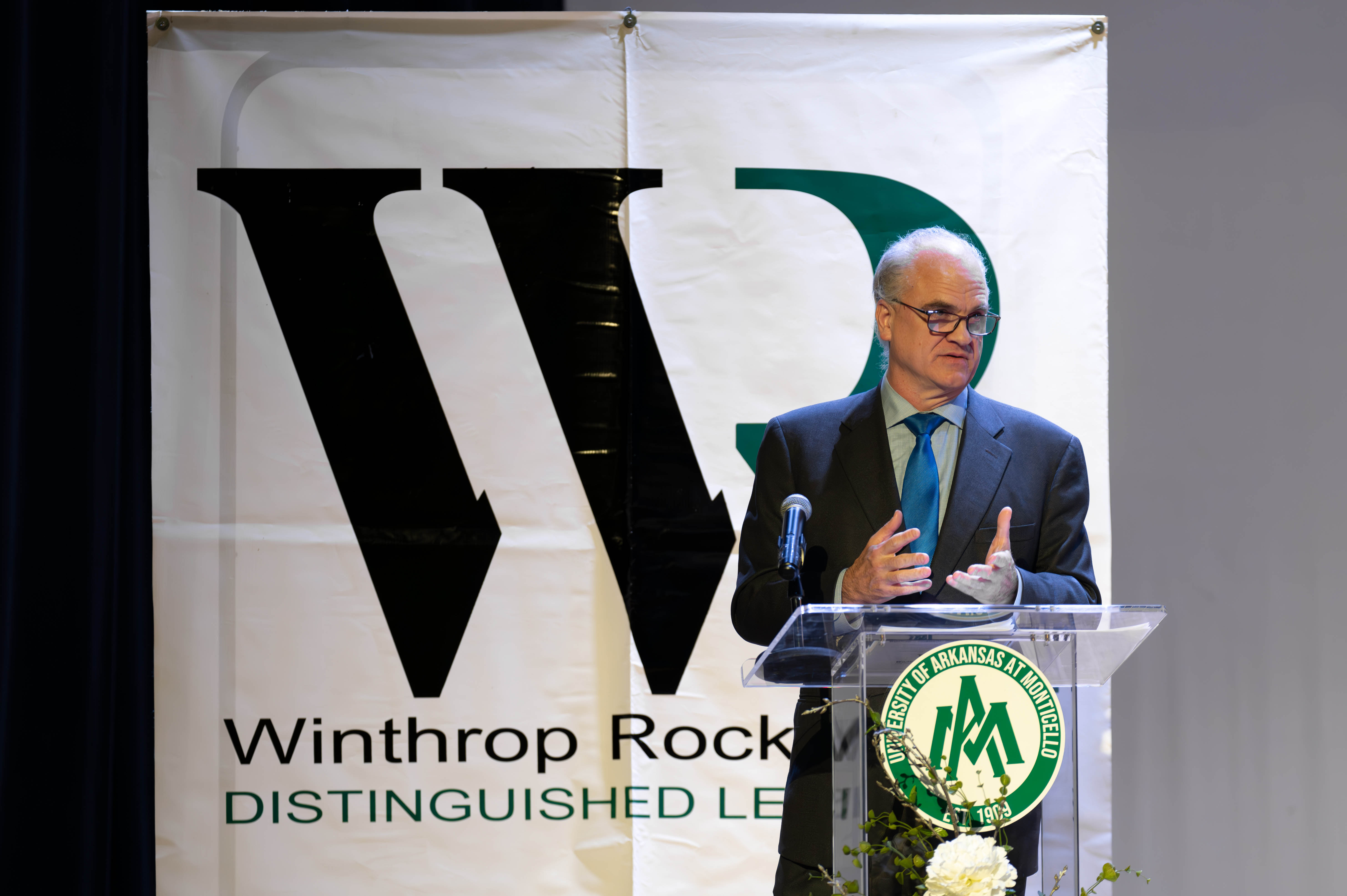
On Friday, April 12, Douglas A. Blackmon, Winthrop Rockefeller Distinguished Lecturer, delivered a free public lecture at the University of Arkansas at Monticello.
Blackmon, a Stuttgart native and Monticello High School graduate, is a Pulitzer Prize-winning writer, scholar, teacher and filmmaker. His first book, “Slavery by Another Name: The Re-Enslavement of Black Americans from the Civil War to World War II,” was awarded a Pulitzer Prize for General Non-Fiction in 2009, became a New York Times bestseller and has been reprinted more than a dozen times. In addition to the award for his book, Blackmon was also a finalist for a Pulitzer Prize in 2011 for coverage of the BP oil spill in the Gulf of Mexico and a member of The Wall Street Journal staff awarded a Pulitzer in 2002 for coverage of the 9/11 terror attacks.
The lecture Blackmon delivered at UAM, titled, “Nothing to Fear: Why True Patriots Should Want to Learn Our Full History — the Good, the Bad and the Ugly,” discussed the importance of confronting the uncomfortable and odious parts of American history.
“We’ve got to find a place where we can believe in each other again, including people we disagree with,” Blackmon stated in his lecture. “If we decide not to listen to anyone who doesn’t agree with us, then we’re setting ourselves up for ultimate catastrophe. Everyone must be willing to temporarily suspend the frustration and anger that we feel. That’s not to say that we give up on our beliefs. On the contrary, we need to have convictions and defend our beliefs. But whatever those convictions are, we need to have enough self-awareness to see the foolishness in ourselves and enough humility to listen to someone else.”
During the lecture, Blackmon praised his former journalism teacher at Monticello High School, Carolyn Ripley, who was in attendance. He credited his success in his career to her journalism class — the only journalism class he ever took — stating, “That class taught me that some things require attention to detail, rigidity and consistency, and if you don’t adhere to those standards, you’ll be confused by what truth and reliability are.”
Dr. Peggy Doss, chancellor of UAM, addressed the audience at the conclusion of Blackmon’s lecture, stating, “I’ve always read and heard that one’s perception is one’s reality. Mr. Blackmon has certainly challenged us tonight with different perceptions, and by doing so, I think that will cause all of us to go home and reevaluate what our realities are.”
From 2012 until 2018, Blackmon was a member of the faculty and a senior fellow in presidential studies at the University of Virginia’s Miller Center of Public Affairs and host of “American Forum,” a 30-minute television interview program seen weekly on more than 250 public television stations across the U.S. Prior to working at the University of Virginia, Blackmon was the longtime chief of The Wall Street Journal’s Atlanta bureau and the paper’s senior national correspondent. He has written about or directed coverage of some of the most pivotal stories in recent American life, including the election of President Barack Obama, the rise of the Tea Party movement and the BP oil spill. For more than a decade, he oversaw coverage of 11 southeastern states for The Wall Street Journal, including directing the journal’s acclaimed coverage of the failed federal response to Hurricane Katrina and the journal’s investigation into the training and preparations of the 9/11 hijackers, as well as immigration, poverty, politics and daily reporting on more than 2,000 corporations based in the region. Blackmon lives in Atlanta, Georgia, and serves as a professor of practice, directing the Narrating Justice Project, in the Creative Media Institute at Georgia State University in Atlanta.
The Winthrop Rockefeller Distinguished Lectures were established in 1972 by friends of former Arkansas Gov. Winthrop Rockefeller. The endowment that funds the lecture program allows six universities in the University of Arkansas system to offer free public lectures that communicate ideas to stimulate public discussion, intellectual debate and cultural advancement.